
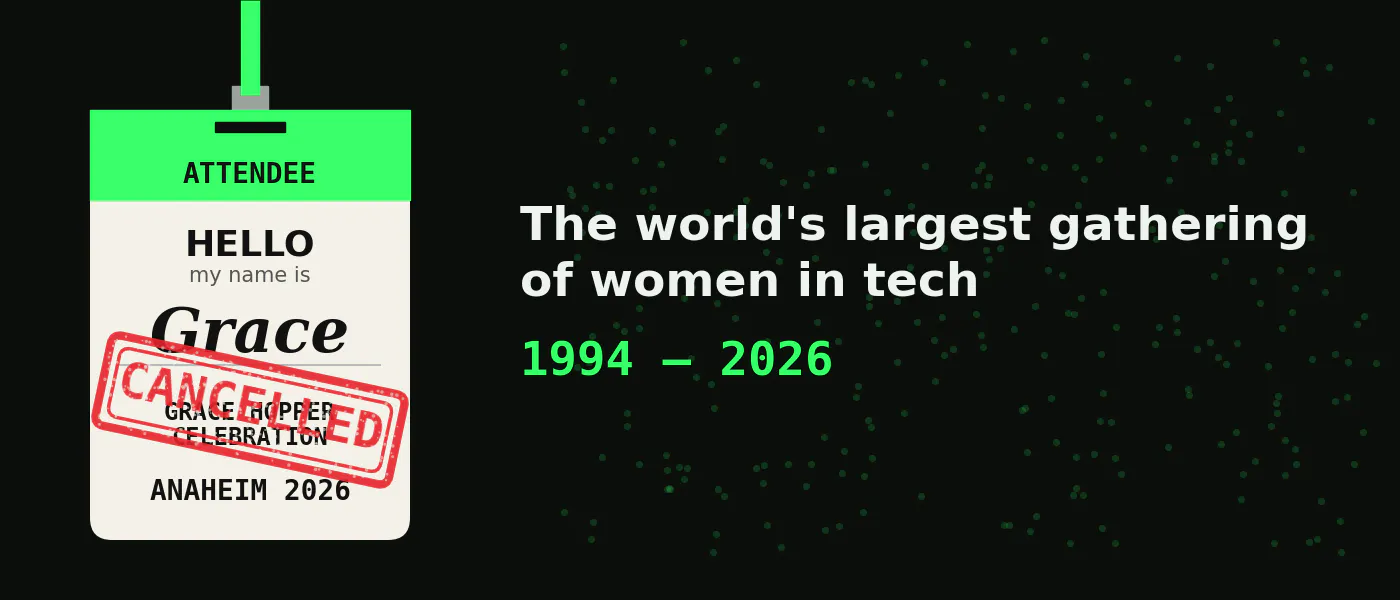
Fourteen days out, the money ran out
On October 13, AnitaB.org cancelled the 2026 Grace Hopper Celebration, the event it bills as the world's largest gathering of women in tech, fourteen days before it was due to open at the Anaheim Convention Center. Both individual registrations and sponsorships came in far below what the nonprofit needed to cover critical operating costs (AnitaB.org). Amazon, Google, Nvidia and Bank of America were on this year's sponsor list, futurist Sinead Bovell had the keynote and Kara Swisher the closing address (Bloomberg via The Philadelphia Inquirer).
Attendees were told to cancel their own flights and hotels, and AnitaB.org said it would contact registrants about fees by October 26. CEO Brenda Darden Wilkerson wrote that the cancellation has "adversely affected our finances" and that the organization is "evaluating strategic alternatives" (AnitaB.org). Read plainly, the parent nonprofit is not sure what it can offer next year, or whether GHC comes back at all.
The news hit Threads before most outlets had a headline, then Hacker News, where the thread reached 259 points and 252 comments (Zeli).
What we've learned since
The money was gone before October. AnitaB.org lost $14.6 million in 2024 on $27.5 million of revenue and $42.1 million of expenses, and the Celebration alone cost $26.9 million to run while bringing in $22.4 million, a $4.5 million hole, according to IRS filings reviewed by Tom's Hardware and summarized by Hoodline.
Attendance had already halved. GHC drew 29,000 people in 2023 and 17,000 in 2024, counting virtual attendees (Hoodline, citing Tom's Hardware). Bloomberg puts 2025 at roughly 15,000, the fewest since 2016 (Bloomberg via The Philadelphia Inquirer).
One piece survives. Grace Hopper Celebration India is still on for January 20–22, 2027 in Bangalore, and companies in the GHC 26 Resume Hub keep access to submitted resumes (AnitaB.org, Hoodline). As of October 19, the press release still promises fee news by October 26 and nothing more (AnitaB.org).
The DEI framing took over the coverage. Bloomberg called it the latest example of the retreat from diversity programs reshaping women's careers in tech (Inquirer), and AfroTech ran it as a loss for diverse tech talent pipelines. The warning signs were public: a year ago, the University of Waterloo's Women in Computer Science group stopped funding student travel to GHC, pointing partly to companies that had publicly defunded DEI (Shari Dunn).
What the internet said
The first word from inside the tent came from the woman who was supposed to open the show. Cathy Hackl, booked as MC, told Forbes: "I'm in shock. The notice just came in." AnitaB.org CEO Brenda Darden Wilkerson signed off the cancellation notice with "we are profoundly grateful, and profoundly sorry."
Then the anonymous forums got hold of it. The top Blind thread by Tuesday morning was titled "RIP Diversity hiring 2012 - 2026," and its opening post read: "Its over. GHC cancelled. Just the canary in the coal mine." The first serious reply pushed back on the premise: "GHC was designed to be a conference without sexual harassment, not 'diversity hiring.'"
On TikTok, @conniecodes posted "GHC was just canceled" and had 1,235 likes and 60 comments within hours; she had been posting about GHC since the 2023 blowup, when her pinned video was about "Grace Hopper student tickets being bought up by men."
On Hacker News, recruiters and teachers showed up first. "Some of the best hires I ever made came through GHC - truly a sad day," wrote roughly. "A bunch of our students already booked travel and rooms," wrote beej71. cmiles8 called it collateral damage: "This always seemed like a good event and only ever heard positive things about it." grahar64 had another theory: "I know that I am dodging US travel ATM." And chasil, on the namesake: "For as much COBOL as my (former) coworkers use every day, they should bankroll her day."
On LinkedIn, women told Bloomberg's reporters they felt "heartbroken" and "angry" (Inquirer). Winnie CEO Sara Mauskopf put it in one line: "Women in tech have been officially canceled." Researcher Amy Diehl's post, seen 16,100 times per Digg, ended: "Truly, society is losing out by not investing in women in tech." Shari Dunn, who worked with GHC while running a nonprofit, wrote that for one week a year there, "nobody was trying to figure out whether you were qualified." Rewriting the Code founder Sue Harnett told Bloomberg that this same week a corporate backer asked whether her group could add a photo of a man to its website (Inquirer).
The reaction reads differently if you remember the last two times GHC blew up online.
In 2020, when the virtual career fair was pulled two days before start, a Blind poster wrote that organizers "chose to tell us this morning that the career fair is cancelled," and another replied that "Lots of people were asking for refunds and calling it a scam." A YC startup, Glimpse, spun up a replacement on LinkedIn with the line "We were devastated to hear the news that Grace Hopper Celebration was cancelled" and claimed 5,000 students in three days.
In 2023, the Orlando career fair was overrun by men. A student paper reported that "dozens of cisgender men flooded into" the convention center, and a Blind thread was titled "GHC 2023 - A failed conference." AnitaB.org's LinkedIn responses were "GHC is over, but this conversation is not" and, quoted by Tufts, "we exist to stand for and with you against this."
Three years later there is nothing left to stand with.
The people who loved it
The anger only makes sense next to the devotion. For three decades, GHC was the conference students wrote home about, and the trip reports are the same from 1994 to 2024.
Dee Weikle, who attended the first one in 1994, remembered it as "small and intimate"; by 2014 she was telling her students that having thousands of women in computing "all there in one place is amazing." A Drexel student wrote in 2015 that it was "the first time that we females overwhelmingly outnumbered the number of males." Dalhousie's recap the same year: "Inspiration was rife and passion was tangible in the air."
The career fair produced the quotes that mattered. Lydia Alonci, an SNHU student and mother, got an Allstate offer by text while waiting for a keynote in 2017. She had joined an online group of alumnae who called the conference life-changing and was skeptical. Her verdict: "I have to tell you, it changed my life." A Washington & Lee senior in 2014: "got many interviews from the companies there." Northwestern's Fizza Jaffer in 2019: "GHC is a mecca for opportunities." A 2019 attendee told SNHU: "My diverse background is accepted and applauded."
The students were the ones who kept it alive. Wesleyan's Caroline Liu, 2018: "I was overwhelmed by the possibility of my future when I left." BU's Theodora Brisimi, 2015: "GHC was inspirational and my participation has been a unique, scientific and social, experience." Maryland's Neelima Pradhan, same year: "the 25 free t-shirts weren't bad either!" Texas A&M's Yvonne Chukwu: "I enjoyed every minute of the conference." A Furman senior took home "one of my favorite pieces of advice was to not downplay." BU's Cassie Lee, as recently as 2024, called it "an unforgettable and transformative experience for me."
That is what the tickets bought. Universities ran scholarship programs to send students, and alumnae came back as recruiters: at least four SNHU graduates who found jobs at GHC returned in 2019 to recruit for the companies that hired them. The "RIP" posts and the "changed my life" posts come from the same community.
The woman on the badge
Rear Admiral Grace Hopper programmed the Harvard Mark I, wrote one of the first compilers, helped create COBOL, and retired from the Navy at 79 in 1986 (HackerNoon). Her Mark II team found a moth jammed in a relay in 1947, the bug behind "debugging" (Postman, Codecademy). Nvidia named its H100 and H200 AI chips after her and was on this year's GHC sponsor list (Bloomberg via The Philadelphia Inquirer). The conference carrying her name still could not pay its bills.
Thirty-two years, one rise and one fall
GHC went from 500 women in Washington, D.C. in 1994 (Wikipedia) to a peak of about 29,000 in 2023, then lost nearly half its attendees in two years (Hoodline, citing Tom's Hardware; Bloomberg).
Anita Borg and Telle Whitney founded it in 1994 (Wikipedia). Borg died in 2003 (Wikipedia); Whitney led the institute from 2002 to 2017 (Wikipedia), when Brenda Darden Wilkerson took over. Growth was steep: about 8,000 in 2014, when Washington & Lee counted 483 men, roughly 6% of attendees; 12,000 in 2015, with 1,352 organizations from 63 countries and $800,000 in student scholarships; roughly 20,000 in 2018 and more than 25,000 in 2019. Then the fall: 29,000 in 2023 and 17,000 in 2024, counting virtual attendees, and about 15,000 in 2025.
What the numbers don't show:
- The career fair was the product. Students are about half the audience; Wikipedia puts the career fair at 70+ companies in its early years, AnitaB.org says 700+ companies participate now. Universities ran scholarship lotteries to send students; USC sent 54 in 2022.
- Open Source Day (2011) and the poster sessions, among the largest at any conference with 175+ posters, gave students and researchers a stage (Wikipedia).
- GHC India (2010) became the largest conference for technical women in India (Wikipedia), and it is the part of GHC still scheduled to run.
- Sponsors were the balance sheet. Capital One, CVS Health, Disney, Goldman Sachs, Google, Intuit and Morgan Stanley (Forbes), plus Amazon, Nvidia and Bank of America this year (Bloomberg). In 2024 the event already cost $4.5 million more than it brought in (Hoodline). When 2026 sponsorship came in far below expectations, there was no event.
The cracks showed earlier. In 2020 the virtual career fair was pulled days before the event and students compared it to Fyre Festival. In 2023, men flooded the Orlando career fair and AnitaB.org promised to listen. Then US companies started scaling back DEI programs after the January 2025 executive orders (Bloomberg), Waterloo's women-in-CS group stopped sending students, and the checks shrank.
Is it savage? Yes. Here's how.
It is savage in five specific ways, and only one of them is the money.
- The timing. Fourteen days out. Flights are booked, hotel blocks are past their cancellation windows, and the notice tells attendees to handle those costs with their providers themselves. People who got visas to attend are told AnitaB.org can't give immigration advice and should ask a lawyer or their sponsor.
- The refund language. AnitaB.org does not promise refunds. It promises to "communicate" about registration fees by October 26, "once we obtain a clearer understanding of AnitaB.org's financial condition." That is the sentence an organization writes when it may not be able to pay them back.
- The audience it lands on. About half of GHC's attendees are students, many on university scholarship money and first-generation. The career fair was where a lot of them got their first offer. Employers are being asked to keep interviews going "directly where possible": the pipeline is now a favor.
- What it says about sponsors. An event with 700 participating companies (Forbes) does not die from one soft year of ticket sales. It dies when Amazon, Google, Nvidia, Bank of America and the rest (Bloomberg) decide a women-in-tech booth is no longer worth the line item. Forbes' Sandy Carter frames the cancellation as a test of whether those companies keep investing in reaching women at all. The press release answers it: sponsorship came in "significantly below our expectations."
- The subtext. The CEO's note says the shortfall has "adversely affected our finances" and the org is "evaluating strategic alternatives" (AnitaB.org), on top of a $14.6 million loss in 2024. In nonprofit language that covers everything from a merger to winding down. The press release does not mention a 2027 Celebration in the US.
The counter-case: the people who pay for GHC had been voting with their wallets for years. Attendance fell from 29,000 to roughly 15,000 between 2023 and 2025, and the Celebration lost money on itself in 2024 (Hoodline, Bloomberg). One Hacker News commenter, badc0ffee, pointed to a r/womenintech thread that blamed neither DEI nor travel: "It sounds like this conference had been going downhill for a few years." A 32-year-old institution two weeks from opening with no money to open was already in trouble; the cancellation is the symptom, not the wound.
What happens to the 15,000
The demand did not go anywhere; the intermediary did. The only path the notice offers is employers continuing career-fair interviews "directly where possible" (AnitaB.org). Expect university women-in-computing groups to pool into regional events, and someone to pitch a 2027 replacement: Rewriting the Code already has 52,000 members (Bloomberg), and in 2020 a YC startup stood up a substitute GHC in three days.
The open questions worth watching: whether refunds actually arrive after October 26, whether AnitaB.org's "strategic alternatives" means a merger or a shutdown, and which sponsors say anything publicly at all.
Sources
- AnitaB.org: An Important Update About Grace Hopper Celebration
- Bloomberg via The Philadelphia Inquirer: Grace Hopper confab's sudden cancellation raises alarm for women in tech
- Tom's Hardware: Grace Hopper Celebration canceled two weeks out
- Hoodline: Grace Hopper Celebration Scrapped Weeks Before Anaheim Start
- Forbes, Sandy Carter: For Women In AI, What The Grace Hopper Celebration Cancellation Means
- AfroTech: Grace Hopper Celebration canceled
- Hacker News: Grace Hopper Celebration Cancelled
- Zeli: HN thread summary
- Shari Dunn: Grace Hopper Canceled, The Cost of the DEI Retreat
- Digg: Amy Diehl's post
- Blind: RIP Diversity hiring 2012 - 2026
- Blind: GHC cancelled this year's job fair (2020)
- TikTok: @conniecodes
- HackerNoon: Women in Tech: Grace Hopper
- Postman: Grace Hopper, the OG Debugger
- Codecademy: Grace Hopper
- Wikipedia: Grace Hopper Celebration
- Wikipedia: AnitaB.org
- Wikipedia: Anita Borg
- Wikipedia: Telle Whitney
- CRA: Grace Hopper Conference archives
- Texas A&M: CSE at Grace Hopper 2015
- Washington & Lee: GHC 2014
- The Iron Warrior: The Virtual GHC (2020)
- Saratoga Falcon: men at GHC 2023
- Tufts: Students attend GHC 2023
- AnitaB.org on LinkedIn, 2023
- Glimpse: GHC Virtual (2020)
- SNHU: Lydia Alonci
- SNHU: GHC 2019
- Eastern Mennonite University
- Cesium: GHC trip report (2015)
- Dalhousie: GHC recap
- Northwestern: Fizza Jaffer
- Wesleyan: Caroline Liu
- Boston University CISE: GHC 2015
- University of Maryland ACES
- Furman University
- Boston University CDS: GHC 2024
- USC Viterbi: GHC 2022